
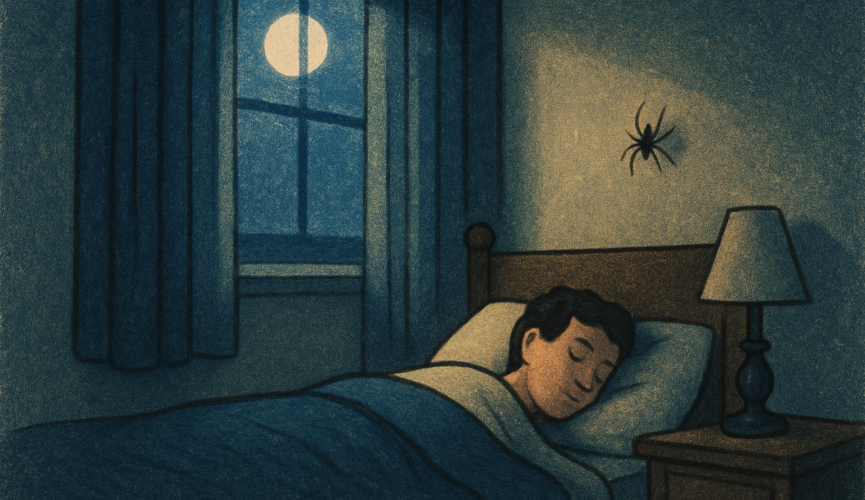
The Claim
Somewhere between a cousin’s wedding toast and a late-night internet forum, you’ve probably heard it: the average person swallows eight spiders a year while sleeping. It’s the kind of fact that sounds specific enough to be true. Eight, not ten, not a dozen. Someone must have counted, right?
Nobody counted. This is one of those claims that gets repeated so often it starts to feel like settled science, when in reality it has never been attached to a real source, a real researcher, or a real dataset. Let’s walk through why.

Where This Legend Came From
The spider-swallowing claim appears to have circulated widely in print and online lists of “weird facts” starting in the 1990s, often presented without any citation at all. Some early versions of the story reportedly originated as a joke about how easily people accept made-up statistics if they sound oddly precise. If that’s true, the irony is hard to miss: a fake fact about gullibility became one of the most successful examples of gullibility in action.
What’s notable is that no entomologist, sleep researcher, or health agency has ever published findings supporting the number eight, or any number close to it. When a claim this specific has been floating around for decades without a traceable origin, that absence is itself a clue.
The “Studies” That Don’t Exist
If you go looking for the original study behind this claim, you won’t find one. Articles that repeat the statistic almost never link to research, and the ones that try usually point to each other in a loop, each citing the last as if that settles it. This is a common pattern with viral claims: a number gets attached to a story, repeated enough times, and eventually treated as fact simply because it feels familiar.
- No published research has ever tracked spider ingestion during sleep in any population.
- No mechanism has been proposed for how spiders would reliably end up in a sleeping person’s mouth.
- No consistent number exists across versions of the claim, which is often a sign the figure was invented rather than measured.
What Actually Happens When You Sleep
Spiders are not drawn to human mouths, and sleeping people are not, generally speaking, appealing to them. Spiders navigate primarily through vibration and air currents, which they sense using fine hairs on their legs. A sleeping human exhales, shifts, and generates enough movement and warmth that most spiders would treat the area as something to avoid, not approach.
There’s also the matter of basic biology. Swallowing is a reflex triggered by something touching the back of the throat. A spider walking across a pillow or even a cheek is extremely unlikely to travel far enough into a person’s mouth to trigger that reflex, especially since the vibrations of breathing alone would likely send it scurrying the other way.

Why Spiders Avoid Us
- Humans represent a large, warm, vibrating mass, which reads as a threat rather than shelter.
- Spiders prefer still, quiet corners, not an environment with regular breathing and movement.
- Most household spiders are more interested in finding insects near walls, corners, and light fixtures than in open bedding.
None of this means a spider has never, in the entire history of humanity, ended up somewhere unexpected. Rare accidents happen. But “rare accident” is a very different thing from “eight times a year, every year, for every person,” which is what the myth actually claims.
The Verdict
Rating: Fiction. There is no credible research behind the number eight, no scientific mechanism that would make it plausible, and strong behavioral evidence from arachnid biology suggesting the opposite is far more likely: spiders go out of their way to avoid sleeping humans, not toward them.
Why This Myth Persists
Part of the staying power here is simple discomfort. Spiders already unsettle a lot of people, so a story that confirms a vague unease feels believable even without evidence. Specific numbers also do a lot of psychological heavy lifting. “Some spiders might occasionally wander near sleeping people” doesn’t spread nearly as well as “you swallow eight spiders a year,” because the second version sounds like it was pulled from a real study.
That’s really the throughline with most claims we look at on this site: precision isn’t the same as accuracy. A number can sound authoritative while being completely unsupported, and the best defense is the same every time, ask where it actually came from, and see if anyone can answer.